Friday, May 15, 2026

Reflection on Volunteer Work at Upendo Secondary School

 By Mees Mouwen, Volunteer @ Mambo in February 2026

During the month of April, I had the pleasure of traveling to Mambo to volunteer at the Upendo Secondary School, specifically focusing on supporting their computer classes. My primary task was to organize and update the school’s older laptops to a more secure Windows 11 environment, ensuring that all necessary educational software was correctly installed so the students would have full access to their curriculum.

The process began with a thorough assessment of the existing hardware. Since quite a few laptops were broken or malfunctioning, I first filtered out the devices that needed repairs or recycling. Once the broken hardware was separated, I could focus my efforts on updating the remaining, functional laptops.

However, the technical setup was not without its challenges. Initially, my installation method failed due to unstable network connections, forcing me to start over and pivot to a different approach. This new method required downloading offline installation packages totaling around 12 GB. Given the local internet speeds, it took a few days just to gather these files. Once downloaded, however, this new approach allowed me to install the software smoothly and efficiently across all the working laptops.

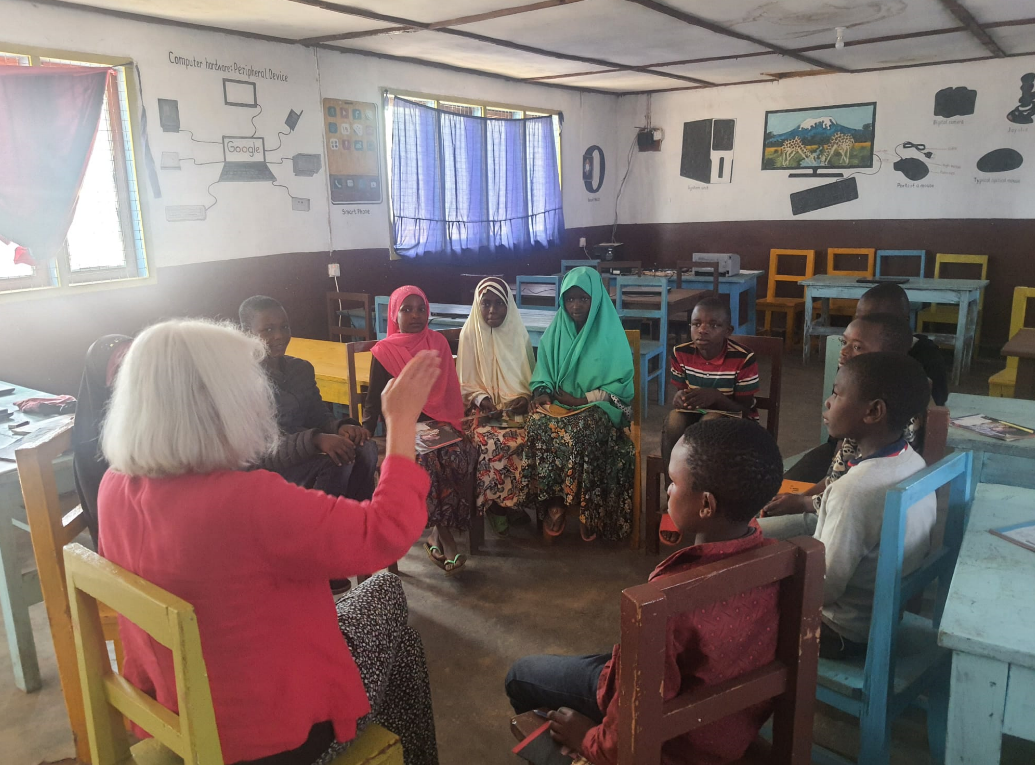
Throughout this process, I had a wonderful collaboration with Juma, the head of the school and the computer teacher. While managing the hardware, I also had the privilege of observing his computer classes and assisting with the practical lessons. These courses primarily focused on the Microsoft Office suite, specifically Word, Excel, and PowerPoint.

Computer classes in action

It was fascinating to observe the classroom dynamics, though I quickly noticed a significant variance in skill levels among the students. For many of these children, these classes represent their only exposure to computers, making it their sole opportunity to build digital literacy. One of my main challenges was understanding this mixed skill level; for instance, some students were working on complex slide animations in PowerPoint while still struggling with basic mouse navigation.

Furthermore, I noticed that the students often lacked the creative or investigative mindset that is so crucial when working with technology. Instead of experimenting to find a solution, they tended to follow strict, linear steps. If they made a mistake or a step failed, their instinct was often to close the application entirely and start over from scratch.

Nevertheless, the school is teaching fundamental skills that will undoubtedly help these students thrive in future careers where digital literacy is required. It is my hope that with these updated laptops, they will have more opportunities to explore, experiment, and develop that vital, inquisitive tech mindset.

Finally, recognizing that the internet is an invaluable resource for problem-solving and independent learning, I collaborated with MamboSteunpunt to set up a small internet router at the school. This new connection will provide the students and staff with internet access, allowing them to learn how to use search engines effectively and find information online independently.

I am incredibly grateful for the opportunity to have contributed to the Upendo Secondary School community and to have worked alongside such dedicated individuals in the Usambara Mountains.


goodbye from Mees

Monday, November 17, 2025

Agroforestry Programme Start-up Lushoto District, Tanzania

Organic Hill Farming Programme Lushoto District, Tanzania 


Introduction of Syntropic Agroforestry Trainings effected in November 2025


1. Short explanation

Syntropic Agroforestry Systems or food forests are a unique form of agroforestry inspired by the functioning of natural forests in space and time. They are forests adapted to the respective agroe-cological zone, where various edible and fodder plants are planted together with trees. The goal is to create a sustainable, self-sufficient system that produces food, fodder for ruminents and wood, thus promoting biodiversity and benefiting the environment, without any inputs from out-side.
Syntropic Agroforestry was developed by the Swiss farmer and researcher Ernst Götsch, who developed the method from 1974 onwards in Germany, Namibia, Costa Rica and Brasil.

The method is built on the following 5 basic principles:

1. Always keep soil covered
2. Maximize photosynthesis
3. Stratification of plant layers
4. Succession in time
5. Active management

Key features of Syntropic Agroforestry:

Biodiversity: A food forest consists of multiple layers of plants, from tall trees to ground cover. This mimics the natural structure of a forest and fosters a healthy, diverse eco-logy. • Sustainability: The system is designed to sustain itself without external inputs like syn-thetic fertilizers or pesticides. • Production: By combining edible and fodder plants with trees, a food forest can offer a variety of food items for human consumption, such as fruits, nuts, vegetables, and herbs as well as fodder for domestic animals and wood.


2. Start-up in the Usambara Mountains – Why?
Mambo (Lushoto District) and its surrounding area has a very high and still increasing population density. The intensive cutting, slashing, burning and farming of the hilly country including the very steep slopes on the Northern edge of the Western Usambara Mountains over the last decades has resulted in an immense destruction of productive land. As a result the area faces tremendous soil erosion as well as soil depletion.


Syntropic Agroforestry can therefore further enhance the Push & Pull – production method introduced to the area by Organic Hill Farming Company Ltd. since 2016. It should

1. Rebuild Soil Fertility
2. Lead to sustainable Land Use
3. Improve Local Food Security
4. Increase Biodiversity Conservation
5. Reduce Erosion Control and soil depletion
As a matter of fact Syntropic Agroforestry should intergrade the elements of Push & Pull between it’s tree lines as an efficient upgrade of the method. 

3. Piloting Syntropic Agroforestry in Mambo area
3.1 Syntropic Agroforestry start-up in Mambo area
During the first two weeks of November 2025 two Agroforest demonstration plots were established in Mambo area. One plot was created in collaboration with MamboViewPoint, a commu-nity-oriented lodge, and the other on a local farm in Chambogo. Both plots were established as part of a two-day-training at each venue. 
With the establishment of these two plots Organic Hill Farming Company Ltd. seeks to find out, what the establishment initially involves, whether the local farmers are sufficiently interested in adapting the method and what support they will require to enable a larger scale Agroforestry Programme

3.2 Budget for the two trainings at the two venues
The effective cost for the preparation and execution of the two trainings including establishment of the two plots amounted to the following: 

The establishment of the two demonstration plots therefore amounted to 7’015’211 TZS or 2’238 CHF including all training material.
During the two trainings a total of 41 farmers were trained in the subject including some 5 guest participants and Mambo View Point personnel, so that they can now disseminate it to their com-patriots.

4. Preparation of the trainings
These steps were taken to prepare and carry out the two trainings:


5. Training programme
5.1 Preparation phase
The preparation of the trainings started on 21st October under the responsibility of Oliver Mrosso along the guidelines of Aron Katosho. 
The preparation activities consisted in: 

Sourcing and provision of the necessary inputs at the sights of training in advance of each training
Selection of participants for each training
Provision of accommodation and food for external experts (Aron, Alex, etc.) in agreement with Mambo View Point
Organization of provision of food and beverages during each training in agree-ment with the owners of the training plots
Sourcing of possible laborers for the two trainings, if required


5.2 List of recommended species for high altitude areas 
The following possible species (seedlings or seed) were recommended for the trainings:


5.3 Required and sourced inputs for each training


5.4 Training programmes
5,4,1 Training at Chambogo village


Thursday, September 11, 2025

Rabies project 2025


Project report One Health Usambara – Rabies 2025


One Health Usambara is a charity project working to improve human health through improving animal health and welfare. One of its most important missions is preventing the spread of rabies, a deadly but preventable disease, through large-scale dog vaccinations.

Rabies-infected animals cross from Makomasi National Park into the Western Usambara region, where local dogs can become infected. Because many of these dogs are cared for by children, they are at a higher risk than adults.

This year, our dedicated team vaccinated an incredible 1,806 dogs; 600 more than last year! Thanks to this effort, the “protective ring” of vaccinated dogs now stretches past the original hub of eight villages around Mambo, down the mountain ridges and out across the plains to Mnazi. As well as keeping people safe, the project teaches families how to care for and train their dogs, strengthening the bond between them.


The project is supported by Linda and Owen Glenn, veterinary surgeons from Northern Ireland, and organised locally by Juma Tupa,  Chairman of Usambara Green Nourishers NGO and Headmaster of Sunga Secondary School, together with Marion and Herman from MamboSteunPunt. Over the years, seven local vets and seven auxiliary officers have been trained to safely handle, health-check and vaccinate dogs. They work to a very high standard and are trusted in the local communities. This not only ensures top-quality care but also creates local employment, making the program more sustainable.


Linda and Owen have funded the project since the beginning. But to help it grow further, reaching more villages and protecting more families and dogs, additional sponsorship is needed and greatly appreciated.  

If you’re visiting the Usambaras, you may even come across our teams at work in the villages. 


Thursday, March 13, 2025

Report Bridge The Gap 2024


BRIGDE THE GAP PROGRAM 2024


During October-December 2024 76 students joined the Bridge the Gap program.

Bridge the Gap was launched with the objective of bridging the educational gap for primary school students, going to the secondary school in Sunga Ward. The project focused on providing comprehensive training in three key areas: computer literacy, English language, and science subjects. This initiative sought to enhance the students' academic and practical skills, better preparing them for future educational and career opportunities.

If you want to support this program for 2025 you can donate via

 https://www.mambosteunpunt.org/donations/

Project Closeout Report: Bridge the Gap
Project Title: Bridge the Gap
Project Duration: 16th September 2024 to 13th December
Location: Upendo Secondary School, Sunga Ward, Tanzania
Project Manager: Juma Tupa 

Objective:

  • To provide access to quality education for underprivileged children, ensuring that no child is left behind.
  • To improve learning outcomes and academic performance of these children through tailored educational programs.  
  • To enhance the overall well-being and future prospects of the children by equipping them with the knowledge and skills needed to succeed in life.

Project Overview:

Bridge the Gap was launched with the objective of bridging the educational gap for students in Sunga Ward. The project focused on providing comprehensive training in three key areas: computer literacy, English language, and science subjects. This initiative sought to enhance the students' academic and practical skills, better preparing them for future educational and career opportunities. 

Key Achievements:

 1. Computer Literacy:

  •   Conducted workshops covering basic to advanced computer skills.
  •  Introduced students to essential software applications, internet use, and digital literacy.
  •  Installed a computer lab with 8 more computers for hands-on learning.

 2. English Language:

  •  Implemented intensive English courses focusing on grammar, vocabulary, reading, and writing skills.
  •  Organized interactive sessions, including debates and group discussions, to improve spoken English.
  •  Provided access to English learning materials, including books and online resources.

 3. Science Subjects:

  •   Delivered engaging lessons in physics, chemistry, and biology.
  •   Conducted practical experiments to enhance understanding of scientific concepts.
  •   Invited guest speakers from local universities to inspire and motivate students.

Impact:

  •   Trained 76 students, significantly improving their computer, English, and science skills.
  •   Increased students' confidence in using technology and communicating in English.
  •   Enhanced students' readiness for secondary education and future career opportunities.
  •   Fostered a culture of curiosity and learning among the students. 

Challenges:

  •   Language barriers and varying levels of prior knowledge among students.
  •   Ensuring consistent attendance and participation. 

Lessons Learned:

  •   The importance of continuous monitoring and evaluation to track progress.
  •   The value of engaging local educators and community members in the project.
  •   The need for flexibility and adaptability in addressing students' individual needs. 

Sustainability:

  •   Established a partnership with local schools to continue offering English classes.
  •   Trained local teachers to take over the science curriculum. 

Conclusion:

The Bridge the Gap project successfully achieved its goal of equipping students in Sunga Ward with vital computer literacy, English language, and science skills. The project not only enhanced the students' academic performance but also empowered them with the knowledge and confidence to pursue higher education and future careers. Moving forward, the established partnerships and sustainable practices will ensure the continued impact and growth of this initiative.

If you want to support this program for 2025 you can donate via https://www.mambosteunpunt.org/donations/


Saturday, November 30, 2024

Organic Farming

 Organic Hill Farming Programme in Sunga and Mbaru Wards


 “Mambo (Lushoto District) and its surrounding area has a very high and still increasing population densitiy. The intensive cutting, slashing, burning and farming of the hilly country including the very steep slopes on the Northern edge of the Western Usambara Mountains over the last decades has resulted in an immense destruction of productive land. As a result the area faces tremendous soil erosion as well as soil depletion. With the reduction of organic matter in the soils this has lead to a severe lack of water storage capacity. Meanwhile certain villages are – in dry years - only supplied with water once a week through one sole water source during the last months of the dry season – an inacceptable situation! The situation has been additionally aggravated by the changing climate, which has shifted the rainfall pattern (belated and shorter rain seasons) and reduced the rainfall in total.

Basically the situation has deteriorated to such an extent that without serious countermeasures on every level the majority of the population will either face severe food and water shortages within the next 5-10 years or then have to migrate to some other area. The effects of climate change and inadequate farming methods are thus very severe!

In 2014 Martin Graf – passing through Mambo with a group of tourists – became aware of the difficult situation in the area and started up “Usambara Push & Pull Programme in 2015. The initial objective was to fight erosion and improve soil fertility as well as introduce Push & Pull methods for the planting of maize. This allowed to reduce the fertilizer and pesticide input.

In 2018 the programme showed significant results with roughly 100 participating farmers. On the other hand the programme could not continue on the basis of external funding by the project initiator, the Paul Schiller foundation and others. It had to become fully sustainable within the local economy.


Therefore first of all the programme, which started off as a simple erosion control and soil fertility programme by means of Push & Pull, had to be focussed on a more integrated approach of organic farming through cooperation with the existing Happy Cow Programme for programme farmers. A crop rotation based on a minimal percentage of fodder production and the subsequent production of manure from ruminants is a precondition for organic farming anyway.

In addition the programme had to be directed towards mid-term economical independence to ensure it’s sustainable forthcoming. For this purpose “Organic Hill Farming Company Ltd.” was founded in October 2020 to take over the programme within Phase II. The respective company office was originally set up in the village of Nkukai with Oliver Venance Mrosso as Managing Director. In 2022 the office was moved to Mambo centre.


Thus the original “Usambara Push & Pull Programme” was transformed into the “Usambara Organic Hill Farming Programme” run by a Limited Company, which must ensure an economically viable execution by the end of 2025.

Meanwhile many programme farmers have caught on and realizied the value of the adapted Push & Pull method and crop rotation for the fertility of their soil, plant health and production level of their crops as well as the value of Elefant Grass and Greenleaf Desmodium as good fodder for their animals. This mainly due to the fact, that they earn good money from the production of Desmodium seed in addition to a crop harvest on the same plot. During the months of September/October 2023 programme farmers harvested a total of 70 kg of Desmodium seed, this year’s harvest increased to a total of 275 kg. The production will continue to multiply, as long as it can be sold to customers.

From 2023 onwards a considerable number of new farmers want to join the programme, whilst those, who have never actively participated, drop out. These new farmers are being introduced to the production method by their successful compatriots within the programme. It is now – after 10 years of engagement – the first sign of an intrinsic motivation amongst programme farmers.”

For support: 

For additional information:

Martin Graf
Email     martin.grafen@bluewin.ch


Sunday, October 6, 2024

Bridge the Gap

BRIGE THE GAP POJECT.
by
UPENDO AGRICULTURAL SECONDARY SCHOOL

Purpose and overview

 A big percentage of students at Sunga and other wards in Lushoto district are at low level of education (primary education). It is approximated that 87% received primary education, 8% receive secondary education but there is huge problem which make most students after join secondary level fail to finish Ordinary level. 

After three years of our research, we observed that those students whose did standard seven exams their parents are unable to pay tuition fees for pre form one course program for three months. This program helps most of pupils to bridge the gap from Kiswahili medium of instruction in primary level for all subject to English language medium of instruction in secondary level. 

A big percentage of families live under low-level of living standard, so after finish standard seven [primary level] Their parents fail to bring them to the PRE FORM ONE ORIENTATION COURSE PROGRAM


However, some children are bright and deserve this program but they are ending up at mass failure in form two National Assessment [FTNA] due various reason in Government schools after joining such as Unconducive learning environment, Teaching style, Distance from schools, Domestic work, Poverty, corporal punishment, pregnancy, poor performance and among Other. However, another reason for poor performance to most students in Sunga ward is imbalance between domestic works and self-studies. Students need time for their self-preparation, after school time. 

This is so different in this ward because after school time students in the evening engaging in domestic works such as feeding animals, collecting firewood, farming cooking, among others. The situation makes most of the students get terrible tired a thing which causes poor self-preparation. A distance is another key factor that discourages students’ success; in some areas students must walk some kilometers to get the schools. No transports that facilitate the home

Upendo

Upendo secondary school situated in Sunga ward is agricultural private school established in 2001. It is a boarding and day school with conducive environment for the students to learn and success. The school with capacity of accommodating approximately 450 students, both boys and girls.

Aim of the project

The aim of the project is to improve education in the community of Sunga and other ward in Lushoto district. This is by requesting some donors to provide some students with scholarships via Upendo secondary school. Moreover, reducing the number of dropouts by raising the level of development in Lushoto and other communities near Sunga through education that will liberate the community members in terms of social, economic cultural activities.


Problem statement

This is not the first bridge the gap program by Upendo secondary school. In some years back, the school was receiving some sponsored students from around Sunga ward and various Tanzanian regions that was living under poor condition, orphanage, and disabilities. Some of the sponsors were individual while others were organizations like NGO’s, foundations, and companies. It is observed that some children are very bright, and they deserve to get bridge from primary level education to secondary level. However, their parents are failing to bring them in Pre form one orientation due to low living standard, some orphans lack opportunity and right to education, some children are originated from the villages situated a quit distance from where the schools found. Some children with physical disabilities need comfortable learning environment that encourage their success. It is evidenced that some orphans are being discouraged by the caretaker they are living with. This is one of the terribly serious issues that draw our attention in writing this proposal. However, all these efforts are to pave the smooth path for the future generation that would for the wellbeing of the community. It is believed that the health community is that one whose people are well educated. The wellbeing of the any future generation is powered by education that will enable them to solve their own social, economic, culture, political problems.

Solution to the problem

This year we started with 60 students sponsored by MamboSteunPunt. Another 10 were sent and paid by their parents. The project is involving a day school [ they come morning and live in the evening] students because it is short time project depending on various factor and criterion set. The project will solve the mass failure; dropping out to those students will receive this project.

Contribute to the project

To facilitate one student is $ 25,- only.

If you want to support this program you can donate via https://www.mambosteunpunt.org/donations/

Thank you in advance

Juma Tup
Headmaster Upendo

with thanks to MamboSteunPunt


Tuesday, July 23, 2024

 Onehealth – stop Rabies by 2030

Starting in February 2014 the “One Health Usambara”  project started to vaccinate all of the estimated 600+ dogs in the area. This year we vaccinated even 1205 dogs since Tanapa, the Mkomazi park owner, did not vaccinate the dogs in Mnazi. Consequently Mnazi has been adopted into the program.

Rabies vaccination of dogs is a critical public health measure that protects both human and animal health, preventing the spread of a fatal disease, and supporting global health objectives. It is a cost-effective and essential intervention to ensure the safety and well-being of communities worldwide.


Rabies remains a significant public health challenge in Tanzania, with an estimated 1,500 human deaths, among them 600 children, annually, although the actual number might be higher.

In Mambo there are reports of people who died within days of being bitten by an affected dog.

Achieving the critical 70% vaccination coverage necessary for controlling rabies has been difficult. In some areas, vaccination rates have been lower than needed, primarily due to logistical challenges, cultural practices, and limited resources.

 In 2018 the WHO launched the Zero by 30 global strategic plan, targeting to end dog-mediated rabies by 2030. Before this already, in 2014 Linda Glenn from the Glenn Vet Clinic near to Belfast, N.Ireland and her son Owen, started to support the people around Mambo by setting up a free Rabies vaccination program for dogs. In the original area, there were a few hundred dogs located which were kept mainly for hunting and guarding. None of them were vaccinated because of lack of resources, lack of education and lack of income to pay for it.

To implement this vaccination program, cooperation from the local veterinarians was needed and five local people were trained as Auxiliary Officers. They were trained in safe dog handling, and vaccination techniques. During the vaccination all dogs also got a general health check ensuring only healthy dogs were vaccinated

The number of vaccinations has increased from 117 dogs in 2014 till over 600 dogs in 2024. In 2022 also the area around Rangwi and the plains area in Mnazi were included. The last became necessary after it became known that various dogs had contracted rabies from the wildlife in the nearby Mkomazi national park. With this, a total population of around 50,000 inhabitants in the Mtae division and another 15,000 in Mnazi division have been protected. Among the latest were many Maasai who are living around the borders of the park.

Another initiative and part of the One Health program in 2024, will be to provide post exposure treatment for free for the people who have been bitten. This will be available via the regular health system, aiming to have full courses of post exposure vaccines available in all health centers in Lushoto district, which is covering the Usambara mountains and Mnazi.

In 2024 the project began to work with a new NGO, Usambara Green Nourishers Organization (UGNO) which has provided essential local expertise and knowledge. It was founded for the execution of the program. UGNO managed to address one of the main difficulties to encourage the many dog owners to join the program. Earlier many did not join because they were not informed about the importance of vaccination or there were rumors that dogs died because of the vaccination.

Many challenges have been overcome by a good education program, training of the Auxiliary Officers and local Veterinarians, ensuring all vaccinations are carried out to the highest of standards and all animals are handled gently and safely.

To reach the WHO goal and provide optimal protection, a yearly vaccination has to be maintained. As the program develops and people understand the importance of vaccination, it is hoped that the dog owners will begin to pay for the program. For the time being, your support is very much appreciated.

 On Google maps you can see all the locations with pictures where has been vaccinated. https://goo.gl/maps/nVMmQeb6o5RLbLyd8

You can donate to this project via MamboSteunPunt with the remark “Rabies”.
www.mambosteunpunt.org/donations